


A Fundraising Project together with University of San Diego
We are Jürgen (59) and Lucie (28) Pressl, father and daughter, and this is our fundraising project. We are united by a rare genetic condition that causes progressive loss of sight.
Few people in the world share our diagnosis: a PRPH2 mutation that slowly degenerates the retina, taking away central vision. Yet, quite a few more likely live with it undiagnosed.

Before The Light Fades
A Fundraising Project together with University of California, San Diego
Partnered P University of San Diego
We are Jürgen (59) and Lucie (28) Pressl, father and daughter, and this is our fundraising project. We are united by a rare genetic condition that causes progressive loss of sight.
Few people in the world share our diagnosis: a PRPH2 mutation that slowly degenerates the retina, taking away central vision. Yet, quite a few more likely live with it undiagnosed.
Help us and others save our sight, one cell at a time.
Total donations collected
$18,105
Goal: $1,000,000
Each donation helps advance research into our rare condition and brings hope to those living with it.


A note about the donation counter
Due to privacy regulations, we cannot see individual donor details. The donation total is updated manually, so recent contributions may take some time to appear. We are deeply grateful for every donation, no matter the size.
1.81%
$0
$270,000
First year
of the project
Retinal organoid development & analysis
$651,018
$1,000,000
Treatment development


A Fundraising Project together with UC San Diego
What Is Our Story?
One and a half years ago, I was diagnosed with a PRPH2 retinal genetic defect.
The doctors were blunt: there is no treatment, no cure, and because it’s so rare, there is almost no research.
_mp4.png)
One and a half years ago, I was diagnosed with a PRPH2 retinal genetic defect.
The doctors were blunt: there is no treatment, no cure, and because it’s so rare, there is almost no research.
"After facing many nightmares and the helplessness that overshadowed my last months, I decided that I won’t allow my diagnosis to take control of me; but that I need to become active. When it is hard to accept that no cure exists, it is time for me to create the path toward one."
- Lucie Pressl, Patient Advocate for PRPH2 Research
The Science: Why the Light Fades
At the core of our vision is a protein called PRPH2, which helps maintain the structure of photoreceptors, the tiny cells in the retina that capture light and turn it into the images we see.
When this protein is defective, that structure begins to collapse and the photoreceptors slowly die, starting at the center of the visual field. Once these cells are gone, they cannot be replaced, which is why this mission is so urgent: we are quite literally racing before the light fades.

How Our Research Could Change Lives
The condition we are fighting is extremely underpopulated, categorized as "ultrarare disease."
Because it is so often undiagnosed, only a few people on this planet share our diagnosis, yet many more are likely affected.
.jpg)
A Shared Fight for the Future
Our fight is fueled by one driving force: Lucie. We are doing everything in our power to ensure she can continue to see this world with her own eyes.
But this project is bigger than one person. Up to 200,000 people globally are estimated to carry a PRPH2 mutation, yet quite a few more remain undiagnosed or misdiagnosed, often mistaken for macular degeneration, for example, or overlooked due to historically limited access to genetic testing. Because it is an inherited genetic condition, it is usually passed down through families, with symptoms typically surfacing between ages 30–50. Because it can take years to correctly identify, some families are left navigating this progressive condition without clear answers. Because the PRPH2 protein is fundamental to human sight, our fundraising could pave the way for treatments that apply to all PRPH2 mutations. By fighting for Lucie’s eyesight, we are building a blueprint of hope for thousands of families worldwide.
.png)

Our Project: Building the Foundation for a Cure
To find a treatment, we must first understand exactly how the "light" is being lost. We are partnering with Dr. Borooah and his team at the Shiley Eye Institute, UCSD, to launch a high-impact, three-year research study.

Because we cannot safely study Lucie’s and Juergen’s retinas without risking permanent damage to their eyes, our study will center around growing retinal organoids from their blood cells: three-dimensional, lab-grown "mini-retinas" that mirror the structure and function of their eye tissue.
.png)

Total donations collected
Raised: $18,105
Goal: $1,000,000
1.81%
Due to privacy regulations, we cannot see individual donor details. The donation total is updated manually, so recent contributions may take some time to appear. We are deeply grateful for every donation, no matter the size.
A note about the donation counter
34.9%
$348,982
Ongoing treatment research and future scientific development
21.0%
$209,935
Creating the Retinal Organoid Model (Human Disease Model)
We are growing and studying our ‘mini-retinas’ that perfectly mimic Lucie’s and Jürgen’s eyes.
-
Organoid Characterization: Developing and analyzing our retinal organoid models to identify and map the precise molecular biological differences between the disease and control cells
-
Biobanking: Securing and banking the cellular material for subsequent gene correction and cellular differentiation phases
SECOND YEAR

THIRD YEAR
17.1%
$170,512
Detailed Characterization
Data Publication
By understanding PRPH2’s complex biology, we can determine how the PRPH2 variant causes disease and test whether RNA repair can reverse the malfunctioning effects.
-
Answering Mechanistic Question: Is this PRPH2 genetic defect caused by loss of function, gain of function, or by a dominant-negative effect?
-
Determining Treatment Strategy: After determining the mechanism, know which therapeutic strategies can be used
-
Treatment Development: We can further develop treatment approaches
OUR STRATEGY
Growing Human Retinal Organoids
Step One: Blood Collection
We start by collecting simple blood samples from Jürgen and Lucie.
In our project uses cutting-edge technology to grow "retinal organoids"
Step Two: Cellular Reprogramming
Using cutting-edge stem cell technology, these blood cells are "reprogrammed" into induced pluripotent stem cells (iPSCs). These versatile stem cells have the unique ability to turn into almost any type of human cell.
Step Three: Organoid Development
Over several months, guided by specific nutrients and growth factors, these stem cells self-organize into 3D retinal organoids, complete with human photoreceptor cells (rods and cones), carrying the exact PRPH2 genetic background.
In parallel, we will create genetically corrected ‘isogenic controls’ (healthy ‘control-retinas’ without the PRPH2 mutation) and compare them to the patient-derived models,
so the team can pinpoint exactly how the PRPH2 mutation causes photoreceptors to degenerate,
laying the essential groundwork for targeted therapies.

THE INVESTMENT
Three-Year Fundraising Roadmap
We are committed to full transparency. Every donation helps directly support the laboratory and its research, specifically funding a Senior Research Assistant dedicated 100% to this project for three years. The goal of our study is to establish a clearer framework for understanding how PRPH2 dysfunction drives retinal degeneration. By developing our retinal organoid model, we will create a strong foundation for all subsequent therapeutic development.
27.1%
$270,571
Stem Cell Generation
(Building the Cellular Foundation)
We are preparing and reprogramming Lucie’s and Jürgen’s blood cells for model creation.
-
Blood Samples: Deriving Lucie’s and Jürgen’s blood samples
-
Cellular Reprogramming: Reprogramming blood cells into 2 human induced pluripotent stem cells (iPSCs) alongside 2 genetically matched (isogenic) controls
FIRST YEAR
Second Year
Second Year
21.0%
$209,935
Differentiation into Retinal Organoids
Second Year
Third Year
17.1%
$170,512
Detailed
Characterization
Data Publication
Second Year
First Year
27.1%
$270,571
Stem Cell Generation
Line Engineering


34.9%
$348,982
Ongoing treatment research and future scientific development
34.9%
$348,982
Building the Path to Treatment
REMAINING FUNDS
The rest of the funds will support ongoing treatment research.
Dr. Borooah and his team are in the early stages of developing an innovative RNA trans-splicing approach.
If the approach proves successful, we can directly test it on our PRPH2 human retinal model to evaluate whether it can correct the underlying molecular defect and rescue retinal cells.

The 3-Step Process
In our project uses cutting-edge technology to grow "retinal organoids"
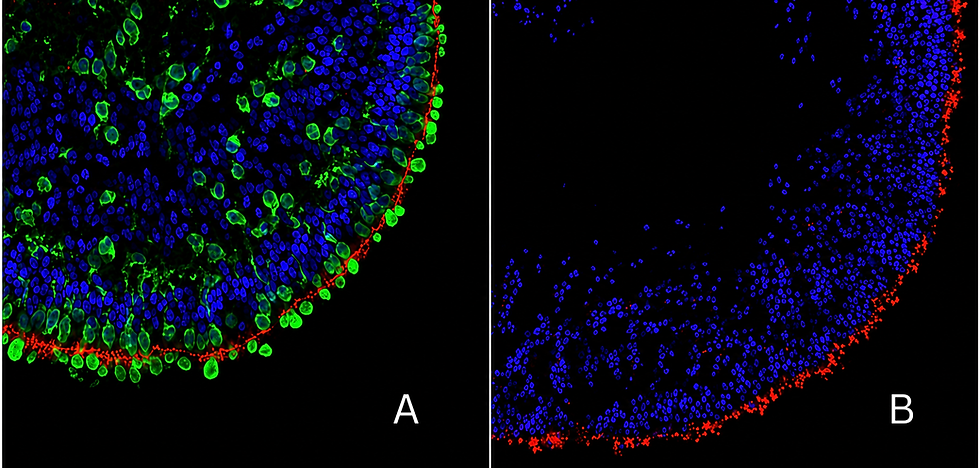
Panel A: These human retinal organoid images reveal a smooth, continuous red rim along the green photoreceptors in healthy tissue.
Panel B: In PRPH2 patient-derived organoids, this red border is patchy or missing, showing how the mutation disrupts light-sensing outer segment formation.
Part of a Larger Research Movement
Over the past 2 years, initial research projects funded through foundations like the Foundation Fighting Blindness and the Nixon Visions Foundation have laid an important starting point for PRPH2 science. Here is a look at how this early momentum is helping move the field forward.
The Foundation Fighting Blindness supports multiple research projects focused on PRPH2 related retinal disease, showing that this mission is part of a wider scientific effort already underway.
Muayyad R. Al Ubaidi
Gene Therapy Approaches
Exploring a strategy to silence faulty PRPH2 genes and replace them with healthy ones.

Award Total:
$481,269.00
Jason Comander
Improving Diagnosis
Studying which PRPH2 mutations cause vision loss to improve diagnosis and treatment.

Award Total:
$500,000.00
Frauke Coppieters
Disease
Differences
Investigating why PRPH2 disease affects people differently and testing new therapies.

Award Total:
$469,728.00

Jason Comander
Yoshikazu Imanishi
Future Treatment Discovery
Researching how PRPH2 mutations damage vision and exploring treatment options.

Award Total:
$481,269.00
$500,000.00
Studying which PRPH2 mutations cause vision loss to improve diagnosis and treatment.
Muayyad R. Al Ubaidi
Gene Therapy
Approaches
Exploring a strategy to silence faulty PRPH2 genes and replace them with healthy ones.
Award Total:
$481,269.00

Frauke Coppieters
Yoshikazu Imanishi
Future Treatment Discovery
Researching how PRPH2 mutations damage vision and exploring treatment options.

Award Total:
$481,269.00
$469,728.00
Disease
Differences
Investigating why PRPH2 disease affects people differently and testing new therapies.

Yoshikazu Imanishi
Yoshikazu Imanishi
Future Treatment Discovery
Researching how PRPH2 mutations damage vision and exploring treatment options.
